Serving Fullerton, CA and surrounding areas.(657) 500-3759
Harbor Fullerton Concrete

Concrete Steps Construction in Fullerton, CA, on a Footing and Not the Fill

Harbor Fullerton Concrete forms entry and garden steps on a footing dug through the sand to the clay and pinned to the house, so the flight cannot drop away from the door. Top riser set off the sill.

Google reviewsFacebook reviewsBetter Business Bureau reviews5.0 Stars How customers score us · Google, Facebook and the BBB
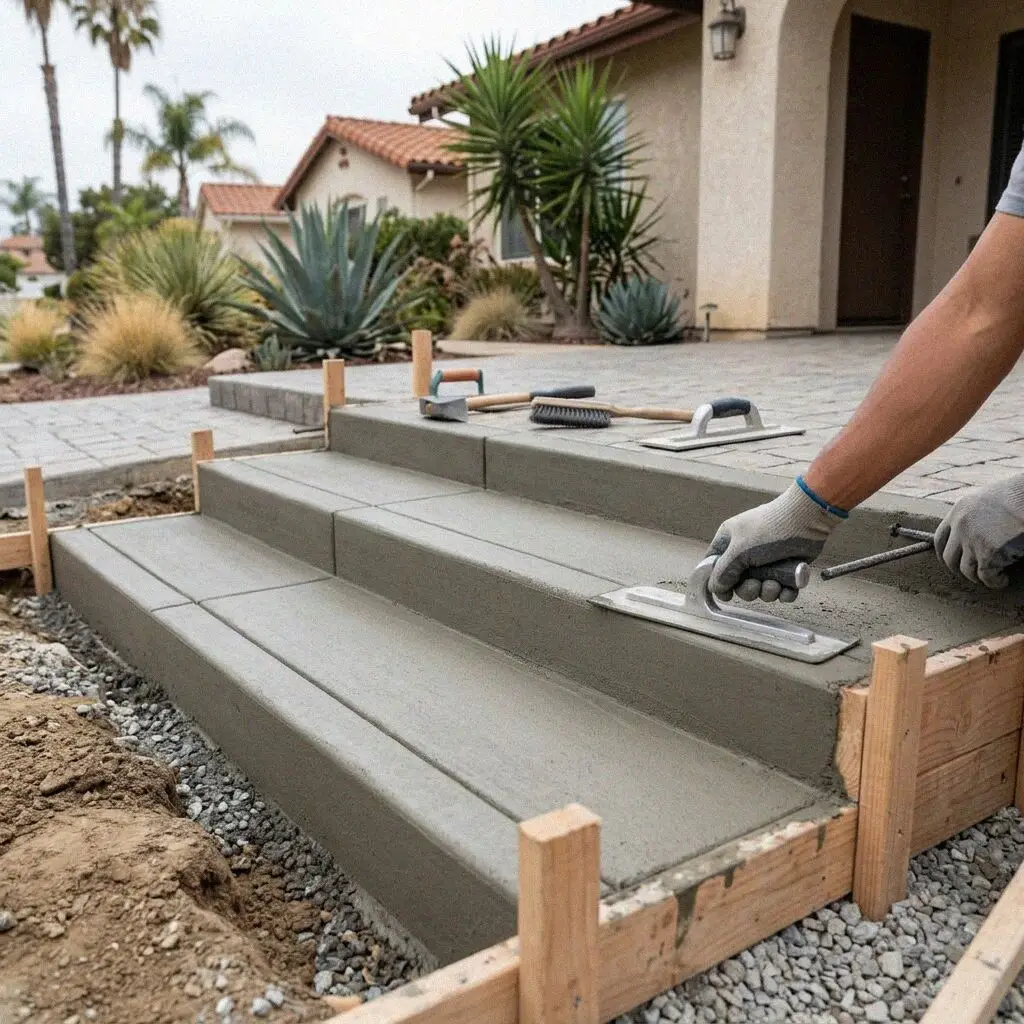
Setting riser forms for new concrete entry steps at a Fullerton, CA house
Hands striking off a fresh tread between riser boards in Fullerton

Risers, footings

Forming a Flight of Steps on a Fullerton Porch

Steps fail by dropping, not by cracking. A flight poured on the loose fill behind a porch settles a little every wet winter, and because the house it meets is on a footing and does not settle, the top riser grows and the bottom one shrinks. The California Residential Code allows 3/8 of an inch between the tallest riser in a flight and the shortest, and a flight that has dropped an inch is a trip at the front door. The cure is a footing that reaches the ground the house stands on.

Harbor Fullerton Concrete has built steps this way since Grant Yoshida started it in 2021, after 14 years on north Orange County crews, and he sets the top riser off the threshold himself. The flights here divide by age. Behind a postwar tract door there are one or two risers off a slab, poured onto whatever the grader left; on the raised-floor houses around downtown and Hillcrest Park, four or five up to a porch; and on the hill lots the garden flight had no footing.

Each flight is formed to the Residential Code, risers no taller than 7 3/4 inches, treads no shallower than 10, a handrail formed for wherever four or more risers stand, and a flight that changes an exit or stands over 30 inches above grade is filed with the city's Building and Safety counter before the pour. The work is licensed CSLB C-8, carries liability insurance on every job, and leaves with a written workmanship guarantee against defects in how it was built.


Repair or replace

When is a Fullerton porch step past patching?

A gap opening at the threshold

A dark line where the top step meets the door sill, wide enough to take a coin, is the flight dropping away from the house. The house has not moved. The steps are on fill, the fill is settling on wet clay, and the gap will widen each winter until the top riser is a stumble.

One riser taller than the rest

Count the height of each riser with a tape. A flight poured level has them equal, and one that has dropped at the bottom end shows a top riser taller than the rest by an inch or more. That inch is where a foot expects a tread and finds nothing, and it is the step people fall on.

Nosings broken off in chunks

The front lip of a tread is the thinnest concrete on the flight, and once it has chipped the tread is shorter than the 10 inches a foot needs. Patches on a nosing bond to the surface and not through it, so they pop off the first winter and the tread is back where it was.

The flight rocking as a block

Press down on the bottom tread and watch the top one. A flight that moves as one piece has a void beneath it, washed out by a downspout or a hose bib that has run under it for years, and the block is sitting on air at one end. That flight comes out, and the void is filled first.

In every flight

Every Flight of Steps We Form in Fullerton Includes

Eight things come with every flight and none is an extra, because each answers what steps meet on a lot here. A house on a footing beside ground that is not, a foot of sand over clay, and a door whose height is fixed.

Old flight broken out

The old steps are broken out to soil and hauled the same day, and the fill behind the porch is dug out with them rather than poured over.

Void and fill checked

The ground under the flight is probed for washout and loose porch backfill, so the steps are never set on air or on soil that will settle.

Footing into the clay

A footing is dug through the sand to firm clay, 12 inches at least, so the flight stands on the same ground the house does and settles with it.

Dowels into the house

Number 4 dowels are drilled and epoxied into the porch or the foundation, so the top step is pinned to the house and cannot drop away from it.

Risers set off the sill

The top riser is measured off the threshold and the rest divided equal within 3/8 inch, because the uneven riser is the one that trips.

Treads with a fall

Every tread drops a quarter inch front to back, so rain runs off the nosing instead of pooling against the next riser and freezing the surface.

Site cleared, rail set

Forms stripped, edges tooled, spoil hauled and the path left clean, with the rail's sleeves cast in wherever the flight has four or more risers.

Walk-through and guarantee

You go up and down the flight with the tape against the sheet, riser by riser, and the written guarantee is handed over before we leave.

Four builds

Fullerton Flights of Steps, Compared

Four ways a flight is built here, set against how many risers it climbs, what it stands on, and when a foot can go on it. The footing and the dowels are common to the first three, so the table is the flight itself and what it asks for.

OptionRisersStands onRailBack in use
Solid poured entry flight1 to 3, each 7 inches or underFooting 12 inches into the clayNone required under 4 risers48 hours on foot
Flight with a landing4 to 8, split at a 36-inch landingFooting under the landing and the footHandrail on one side, sleeves cast in48 hours on foot, 7 days for the rail
Garden flight down a bankAs many as the slope needs, 6 inches eachEach tread on its own compacted baseHandrail from 4 risers up48 hours on foot
Recast treads, old flightSame count as the flight underneathThe old flight, if it has not droppedWhatever the old flight has24 hours on foot

The solid flight costs least and lasts longest; recasting the treads over a sound old flight is the cheapest of the four and the one that depends on what is under it.

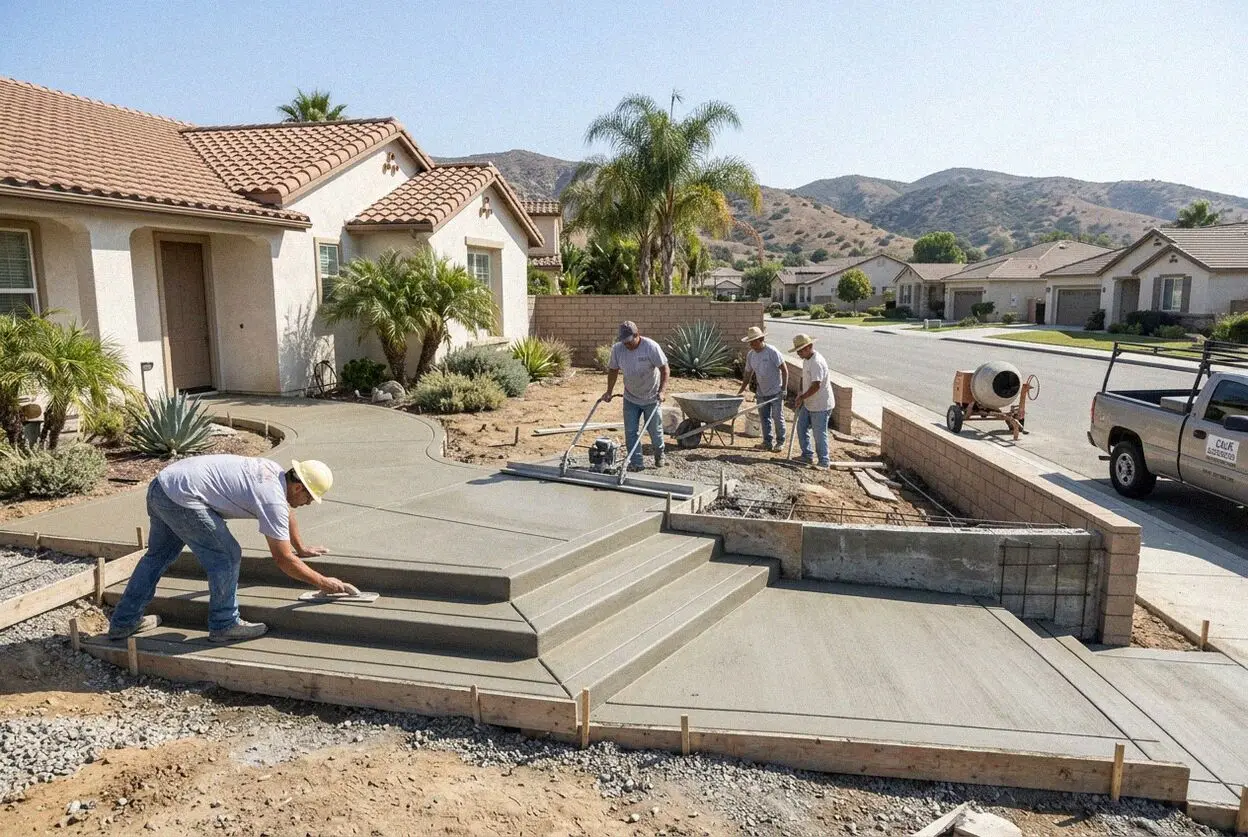
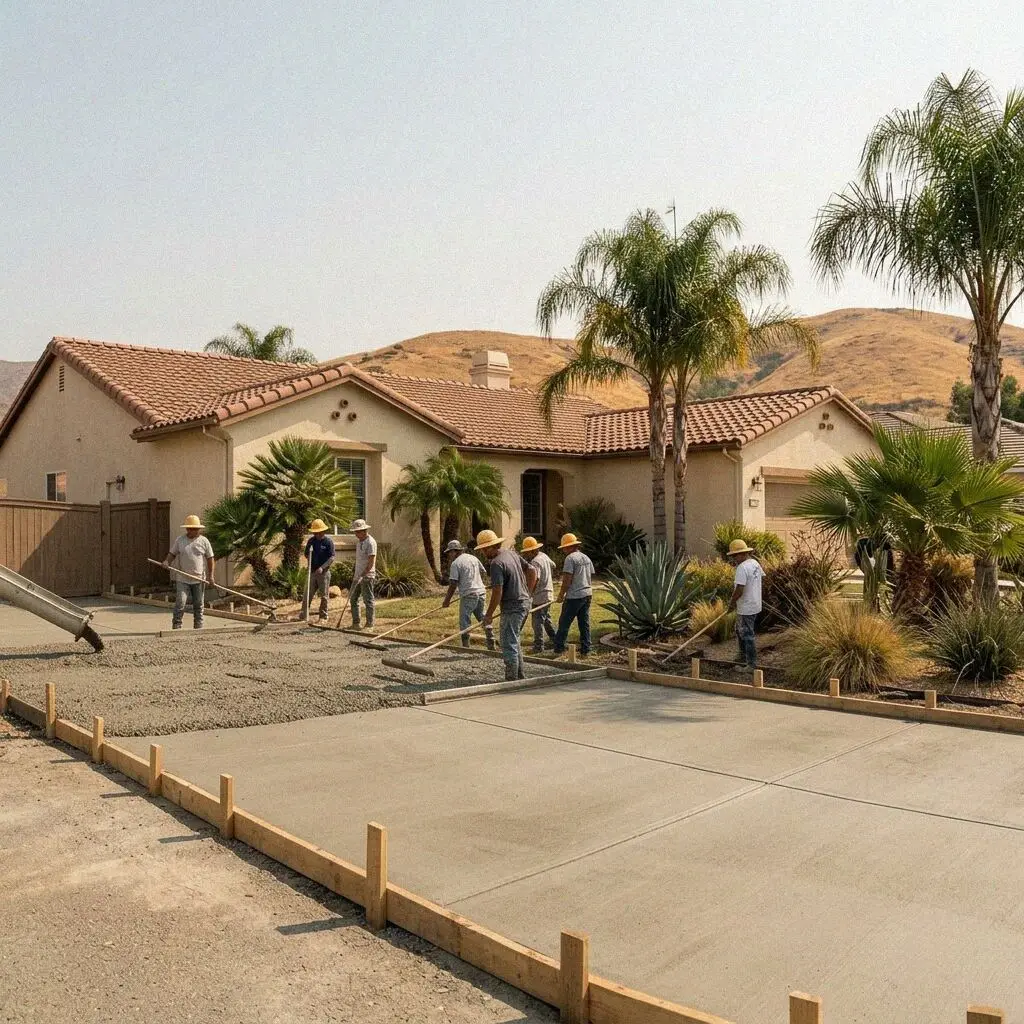
Concrete crew forming a flight of porch steps at a Fullerton home

Doors and ground

Why Steps Drop Away From a Fullerton Door

Two things decide a flight here, and the concrete is neither. A door whose height was fixed decades ago, and the fill under the steps that was never compacted to reach it.

Every postwar porch in the city was built the same way. The slab was poured, the yard was graded to it, and the two risers at the front door were formed on the fill the grader pushed back against the porch. That fill sits on the sandy top foot, and under it is the clay that swells every winter and shrinks every summer, so the flight rides up and down a fraction each year and rests a little lower each time. After sixty years a Sunny Hills top riser is often an inch taller than poured.

The older streets set the other problem. The Craftsman and Spanish houses around downtown and Hillcrest Park were built on raised floors, so their entry flights climb four or five risers to a wooden porch, and the original steps were rarely on a footing. A flight that tall needs a handrail under the Residential Code and a footing that reaches the clay, and on a hill lot the garden flight often wants a retaining wall beside it.

From call to cure

How We Build a Flight of Steps in Fullerton

Five stages, one crew, and the person who measures the threshold is the person who sets the riser boards. A front door is out of use for about three days, and a flight that changes an exit is filed before the old one comes out.

1

Measure the rise, probe the fill

Grant Yoshida shoots the height from ground to sill, divides it into risers, probes under the old flight, and writes the figure at the door.

2

Choose the build and the week

You settle the tread depth, the finish and whether a rail is wanted, and take a date. A flight over 30 inches or a changed exit is filed first.

3

Break out and dig the footing

The old flight and the fill behind it come out, the footing is dug into the clay, and dowels are drilled and epoxied into the house.

4

Form, set the steel, pour

Riser boards are set off the sill and checked with a tape, rebar tied to the dowels, and the flight poured and finished tread by tread.

5

Strip, cure and hand over

Forms stripped the next morning, nosings tooled, the flight kept damp for seven days, and the sheet handed over on the walk-through.

Behind the number

What Decides the Estimate on Fullerton Steps

The number of risers starts the figure and what the old flight stands on finishes it. Two flights of the same height can differ by a day once the probe goes in, so nothing is priced from a photograph. Every estimate is measured and written on site.

A tract front door

One or two risers off a postwar porch is the shortest job on the list, and the figure moves mostly with how much fill has to come out behind it.

A raised-floor house

Four or five risers up to a downtown porch add a landing, a rail and a deeper footing, and the rail is formed for on the day, not drilled in.

A garden flight on a slope

A hillside flight is measured by its length and its bank. Each tread is cut and based on its own, and a wall beside it is priced as its own line.

Bullnose, color or stamped

A rounded nosing, an integral color or a stamped tread is a second pass with the forms still on, and each is written as its own line on the sheet.

The measure and the written figure cost nothing, and the call to book a time for it comes back within 1 business day of your form or your message. (657) 500-3759 or send us a message.

Want your Fullerton steps measured at the door?

Send the form or ring the yard and someone calls back within 1 business day to fix a time. Grant Yoshida shoots the rise from the ground to your sill, probes under the old flight and writes the figure on the porch, yours to keep.

Request a Free Estimate

Written on site · No obligation

By submitting, you agree to our disclosure and consent terms, including being contacted by Harbor Fullerton Concrete.

Flights rebuilt

Three Fullerton Flights of Steps, in Their Owners' Words

Three reviews from Google, Facebook and the BBB, each about a flight of steps rather than a slab, and each naming the risers or the drop that was put right.

Google review

“The top step at our front door had sunk until there was nearly a two-inch gap under the sill, and my mother tripped on it twice. They dug the old fill out, put a footing in and pinned the new flight to the porch. Three risers, all the same on my tape, and it has not moved in two winters.”

Janet H. of Golden HillsFront porch steps rebuilt · Google · 2024
Facebook review

“Our house is a 1920s bungalow near Hillcrest Park with five steps up to the porch, and the old brick ones were leaning away from it. Grant formed a new flight with a landing and a rail, sleeves cast in the pour so nothing was drilled later. It looks like it belongs and it has not moved.”

Marcus D. of downtownFive-riser porch flight with rail · Facebook · 2025
BBB review

“We have a bank behind the house in Raymond Hills and the old garden steps had washed out and tipped. The crew cut fourteen treads into the slope, each one on its own base, with a rail on the open side. They were poured in a day and a half and we were using them the weekend after.”

Elena V. of Raymond HillsFourteen-tread garden flight · BBB · 2023

Before you book

Questions About Steps We Are Asked in Fullerton

What moves the figure on a flight, how long the door is out of use, what the city files, what is guaranteed, and what concrete and steel go into the steps, answered for a porch here.

(657) 500-3759
  • What makes one set of steps dearer than another?

    The number of risers, what the old flight is standing on, and whether a rail or a landing comes with it. Two risers off a tract porch over clean fill is the smallest flight we form; five up to a raised floor, with a landing and a rail and a void under the old flight to fill, is a different job at the same address. The rise is measured and the ground probed at the door, and the figure is written there.

  • How long is the front door out of use for?

    About three days. A morning to break out the old flight and dig the footing, an afternoon to drill the dowels and set the forms, a day to pour and finish, and the forms come off the following morning. The flight takes feet after 48 hours, though it is kept damp for seven days. If the front door is the only way in and out, say so at the visit and a temporary timber step is set up beside the pour for the three days.

  • Does the estimate include taking the old steps out?

    Yes. Breaking out the old flight, digging out the fill behind the porch and hauling both is written into the figure, as is the footing and the dowels into the house. What sits outside it is named at the visit and never added afterward. A void under the old flight that has to be filled with slurry, a rail you choose in metal rather than a formed sleeve, or a porch slab found broken once the steps are off it.

  • Do new porch steps in Fullerton need a permit?

    Not usually, and yes in two cases. A flight replaced in the same place, at the same height and off the same door is flatwork the California Residential Code does not permit separately. A flight that changes the exit from the house, or one whose top tread stands over 30 inches above the ground and so needs a guard, is filed with the city's Building and Safety counter, and the rail and guard inspected. We file it.

  • Can a settled step be claimed on home insurance?

    Almost never for settling. A flight that has dropped over decades on wet clay is treated by every policy as ground movement and maintenance, and it is the owner's to replace. A flight undermined by a burst supply line, or struck by a vehicle backing onto the porch, is a sudden event and may be covered. Photograph the gap at the sill and the riser heights before anything is broken out, and ask your carrier first.

  • Which parts of the new steps are guaranteed?

    How they were built. The footing depth, the dowels into the house, the riser heights within 3/8 inch of each other, the tread fall and the finish, all on the sheet you sign. It is a written workmanship guarantee against defects in how it was built. Chipped nosings from a dropped tool, surface wear, and staining from a rusting rail sit outside it. If the flight drops from the door through the build, we rebuild.

  • What concrete and steel go into a flight of steps?

    A 3,500 psi ready-mix poured in one lift so no tread is a cold joint on the one below, number 3 rebar tied on a grid through the flight, number 4 dowels epoxied 6 inches into the porch or foundation, and a footing carried into the clay. The nosings are tooled with a radius rather than left square, because a square edge is the first thing to chip. The mix and the steel are named on the sheet before you sign.

  • Do I need to be there when the steps are poured?

    Only for the measure at the start and the walk-through at the end. Between the two the crew needs a hose, the porch light off the circuit if the dowels go near it, and the door kept shut for the day of the pour. Anyone in the house who cannot use a temporary timber step should say so at the visit, and the flight is poured in two halves so one side is always walkable.

Towns we pour in

Concrete Steps Formed Around Fullerton

The eight nearest towns on the list, each with its straight-line distance from the yard on Harbor Boulevard. Every flight is measured off the threshold at the door before a figure is written.

Show All Areas We Serve

Have your Fullerton front steps measured this week

Ring the yard on Harbor Boulevard or leave the form, and we come back to you within 1 business day. Say how many risers there are now and whether a gap has opened at the sill, and the measure at your door is booked inside the week.