Serving Fullerton, CA and surrounding areas.(657) 500-3759
Harbor Fullerton Concrete

Concrete Patio Construction in Fullerton, CA, Built Over the Claypan

Harbor Fullerton Concrete lays garden slabs 4 inches over base that replaces the clay horizon, sawn the day of the pour and finished with grip in it. Every estimate is measured and written on site.

Google reviewsFacebook reviewsBetter Business Bureau reviews5.0 Stars How customers score us · Google, Facebook and the BBB
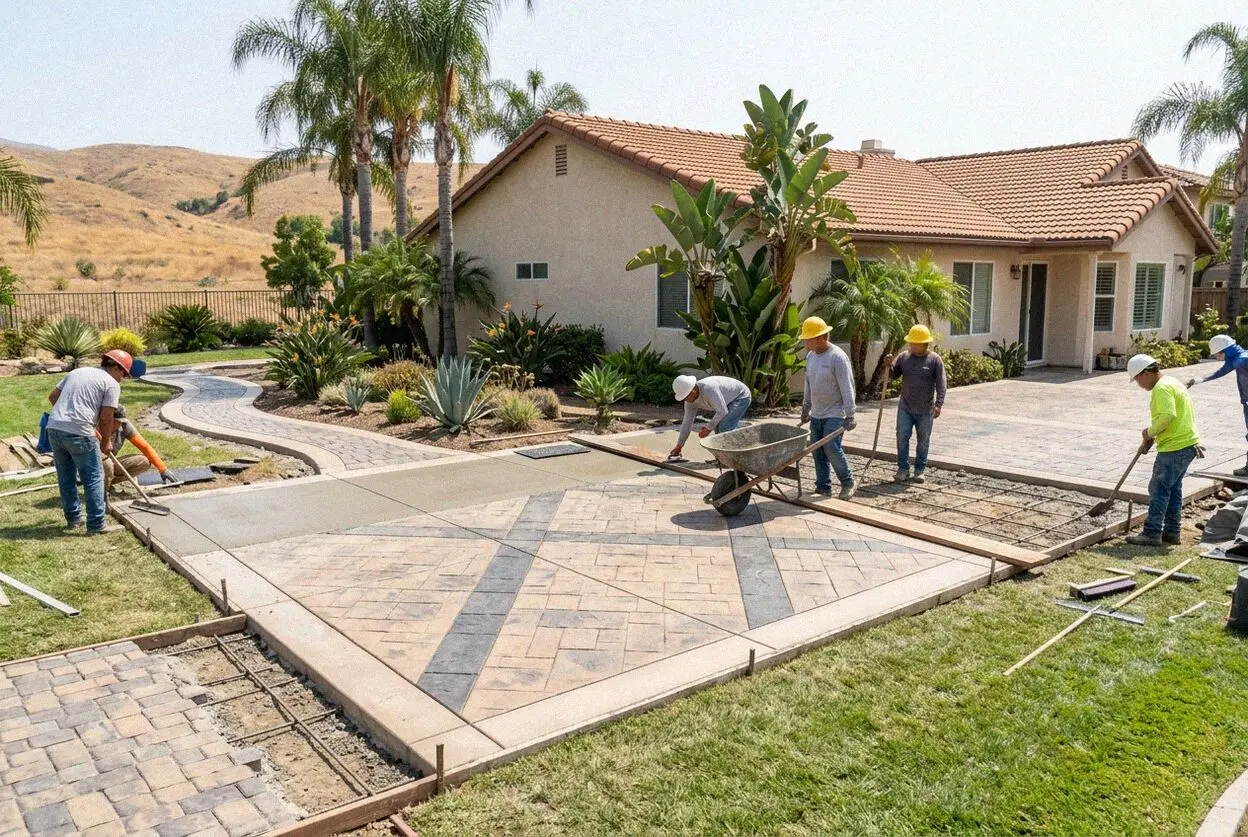
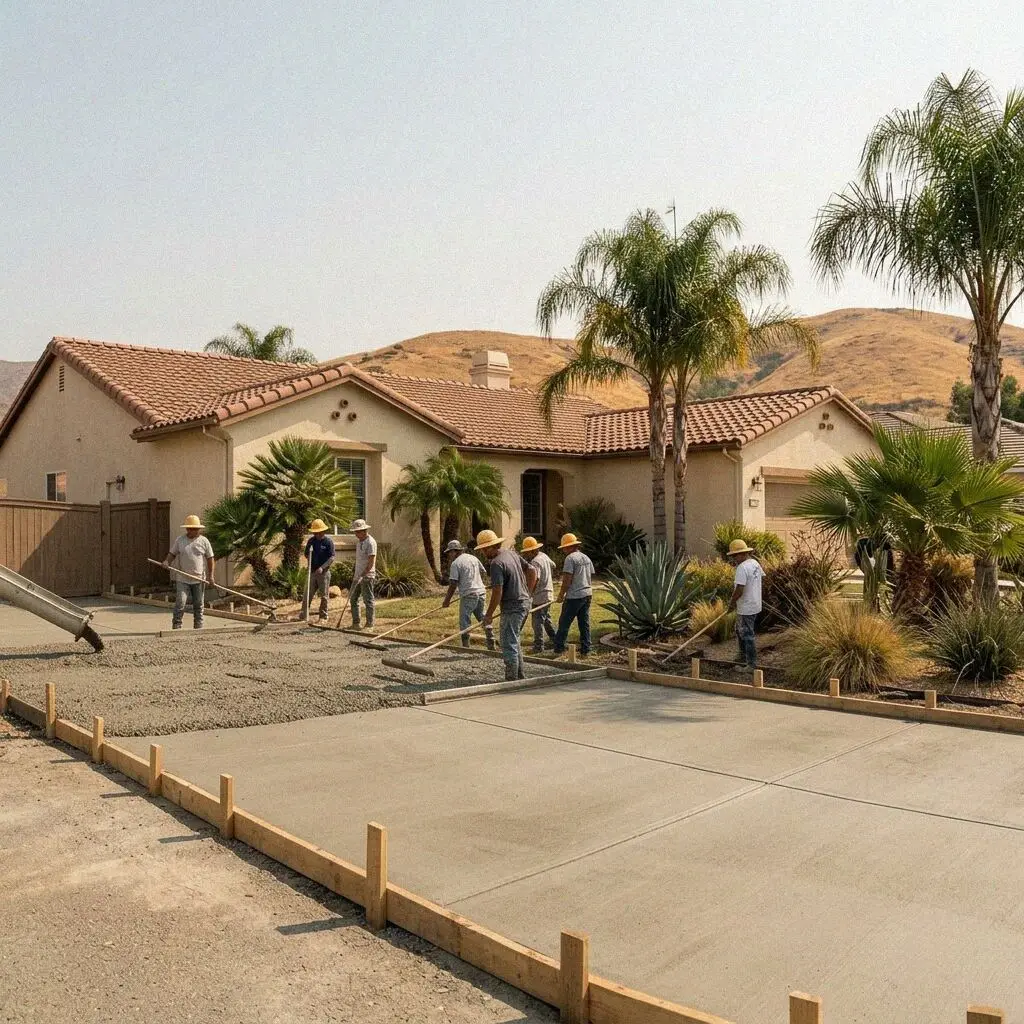
Concrete patio slab being placed in a Fullerton, CA back garden
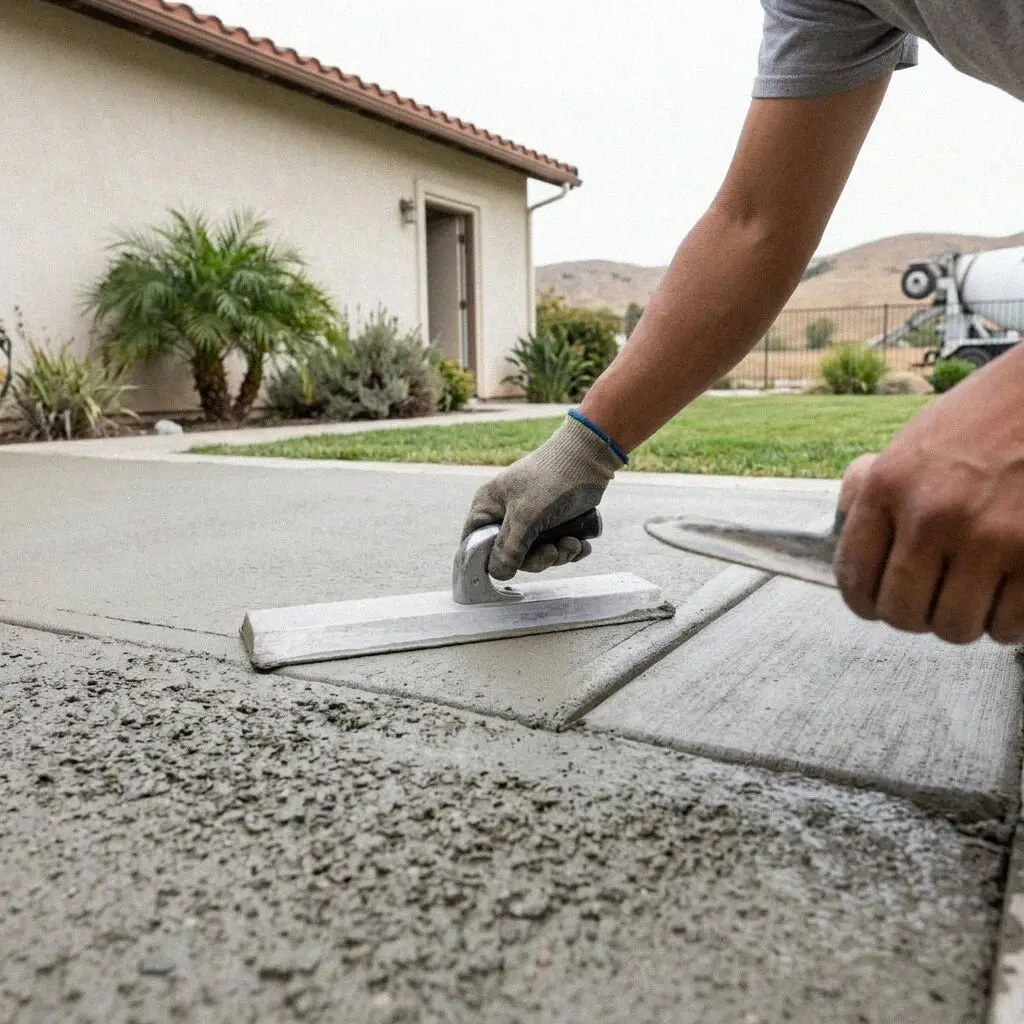
Finishers brooming a new back-garden patio slab in Fullerton, CA

Patios on this ground

How a Patio Gets Built on Fullerton's Sandy Loam

A back-garden slab is the thinnest concrete on a Fullerton lot and the only part with nothing standing on it. The first foot digs like sand across most of the city, then the Myford horizon arrives near 40 percent clay, at a linear extensibility of 6.4, the high end of shrink-swell. Winter rain reaches it through turf watered all summer, so it swells, then shrinks back by September. Weight rides a driveway through that. A patio has none, so it must be built to sit still without it.

Grant Yoshida has held the C-8 since the yard opened in 2021, having put 14 years into crews across north Orange County first, and he pegs out every patio himself. Of the 52,300 homes in this city, 33,200 date from the three decades after 1950, so the slab coming out is usually somebody's 3-inch original, laid straight onto dirt at the back door. Those same decades fixed the side return at roughly the width of a dustbin, which is why the way in gets measured ahead of the outline.

Work here follows the California Residential Code, the classification behind it is C-8 Concrete, backed by liability insurance on every job. The code exempt list reaches driveways and sidewalks, so no patio slab appears on it; nor does Building & Safety publish an exemption list of its own; applications go through EasyDev. Your address therefore goes up to the second-floor counter on Commonwealth as a question. Put a roof above the slab and it is drawn and filed regardless.


Warning signs

Four Signs a Fullerton Patio Wants Replacing

A lifted edge at the lawn

A patio edge standing proud of the grass in February and sitting level again by September is the clay under it taking water off the border and handing it back. Grinding the lip moves the argument along a year. Cutting that clay out and compacting rock into the space is what ends it.

A gap open at the house

Tract patios here went in hard against the stucco with nothing between the two, so the first season the ground moves the slab leans on the wall and then parts from it. Rain runs down that gap and into the stem wall. A sealed strip and a re-poured edge close it. Caulk does not.

Slick on a gray morning

A steel-troweled top holds the film the marine layer leaves on it, and from May into July that is most mornings in this city. Etching and a grip sealer buy a season or two. A texture worked into the surface while the concrete is still soft is the version that keeps working.

Cracks running with the fall

On the graded lots below the Coyote Hills, and up through Raymond Hills, half the garden is cut and half is fill, and the filled half keeps going down. A crack tracking the slope rather than crossing it is that, not shrinkage. Only a proved subgrade and a keyed edge hold it.

What's included

What Every Fullerton Patio Comes With

Eight things in every garden slab we lay. None is optional, none turns up later as an extra, and each answers something this ground or this climate does to thin concrete: the clay a foot down, the film a damp morning leaves, and a side return built narrow.

Clay depth measured

A hole is opened while the estimate is being written, so where the clay horizon starts under your garden is a figure and not a guess.

The route in boarded

Plywood goes over the turf, the gate posts and the paving before a single barrow moves, and the run is hosed down each evening.

Base compacted in lifts

Angular rock is placed in layers and plated between each one, replacing enough clay that the slab ends up bearing on stone.

A strip at the stucco

A compressible joint parts the slab from the house, so the season is taken up by the strip rather than leaned against your stem wall.

Fall set off the wall

The screed carries a quarter inch of drop per foot, off the house and into the beds, so a winter storm has nowhere on it to stand.

Sawn the same day

Control joints are sawn inside 12 hours, in near-square panels and out of each inside corner, so the cracking lands where we chose.

A finish with grip

Broom, texture or exposed aggregate is worked in while the top is soft, because a polished surface holds the morning damp and turns slick.

Watered a full week

A curing compound is put down as the crew packs up, and seven days of watering follow it, which is what leaves a top hard and not dusty.

Your options

Four Patio Surfaces Over a Fullerton Claypan

Four surfaces set against what a shrink-swell horizon and a damp morning do to them: how long each lasts, where on a lot in this city it belongs, what it asks of you once it is down, and how long the garden is out of use.

OptionYears of serviceWhere it fitsUpkeep it wantsTime on site
Broom-finish concrete30 to 40 yearsPostwar tract gardens on the claypanSealer every 4 to 5 yearsPoured in a day, 7 to cure
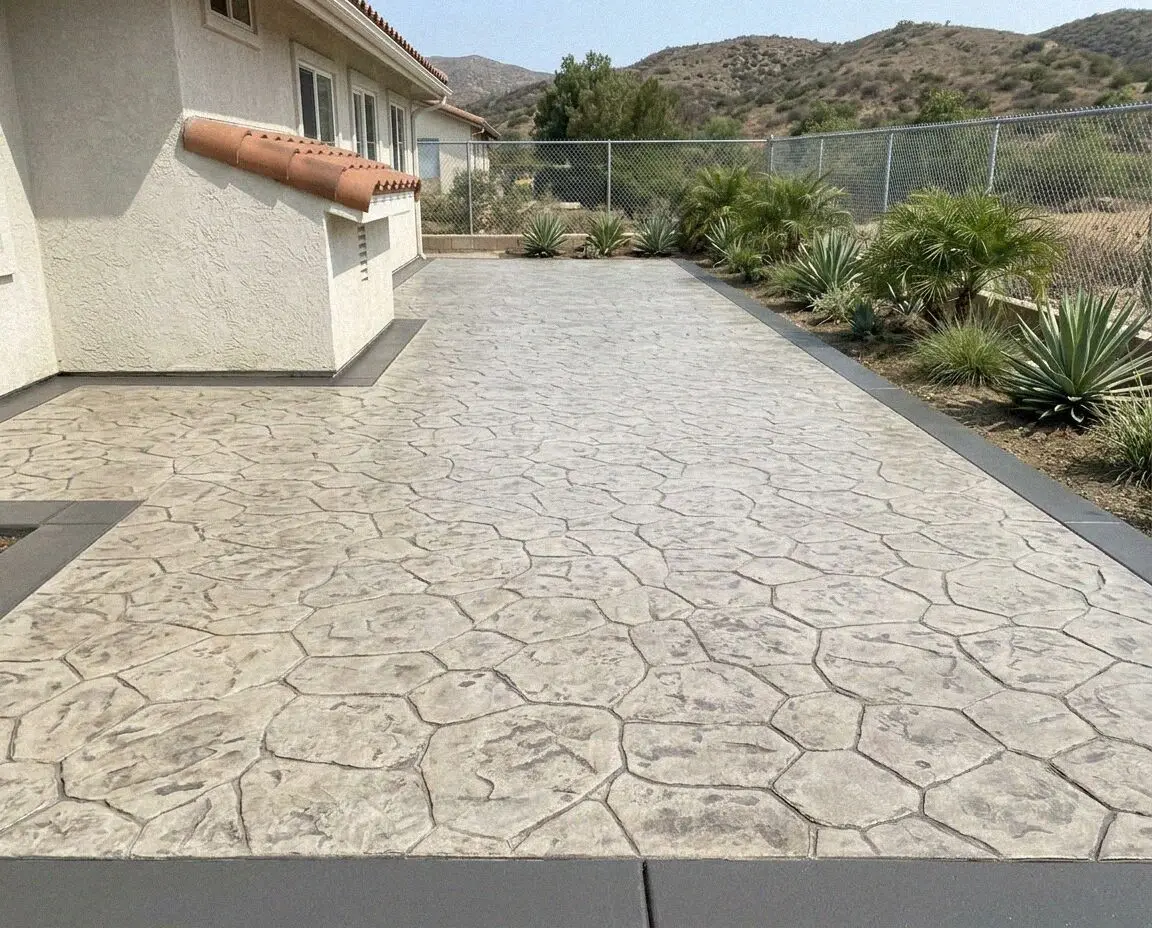
Stamped concrete25 to 30 yearsAmerige Heights and the newer buildsSealer every 2 to 3 years2 days down, then 7 to cure
Exposed aggregate35 years and upShaded returns that stay dampSealer every 4 years, rinse in spring2 days down, then 7 to cure
Interlocking pavers30 to 50 with upkeepCut-and-fill lots under the Coyote HillsRe-sand the joints once a year2 to 3 days, no cure

Below the top half inch the first three are one slab. What separates them is grip once the marine layer has been through, and how often the surface wants a sealer.

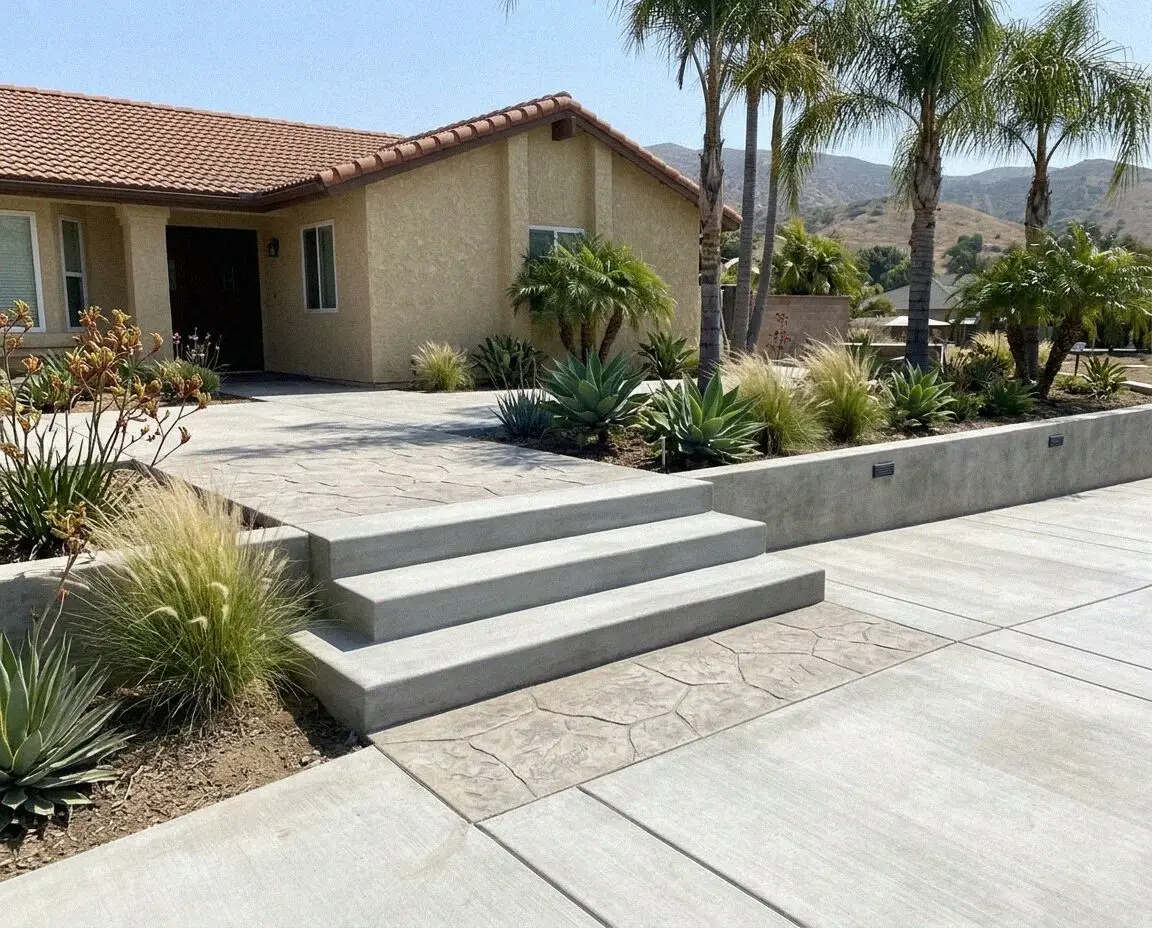
Broom-finish patio behind a 1960s tract home in Fullerton, CA

Local knowledge

The Claypan, the Coyote Hills and the Marine Layer

This is not one ground. Four soil series meet inside the city limits, and the patio, thin, unloaded and watered right at its edge, reads the difference well before anything else on the lot does.

North and through the center the map unit is Myford sandy loam, sand for the first foot, then a horizon near 40 percent clay carrying a linear extensibility of 6.4. Downtown along the old creek line that gives way to Metz loamy sand, which drains. East and south it is Mocho loam. Under the Coyote Hills the pads were cut into a graded slope and filled behind. The USDA Web Soil Survey will show you which one your garden sits on; the hole we open confirms it on the day.

The other half of the story is the calendar. The municipal airport station puts July at 84.4 degrees and August at 86.7, the mildest pair of figures anywhere we pour, so a patio here is furniture left out most of the year rather than a room used for one season. What limits the work is the reverse of heat: from May the marine layer sits over the city into late morning and holds water on the surface, so finishers wait it out instead of working it in.

Our process

The Five Stages of a Fullerton Patio

Five stages between the morning the outline gets pegged and the afternoon the table goes back out. One crew throughout, one figure agreed at the start, and the barrow route settled before any concrete is ordered.

1

Pegged out on site

Grant Yoshida walks the garden with you, pegs the shape full size, digs to the clay and takes the gate width. The figure is written there and then.

2

Finish, joints, a date

Surface and joints are settled outdoors, on the ground itself. If a roof goes above the slab, that reaches EasyDev before any date is set.

3

Breakout and boarding

The old slab and everything loose beneath it come out to depth, boards go down the way in, and the subgrade gets proved before rock is ordered.

4

Base, forms, concrete

Rock goes in and is plated in layers, forms come up to the fall you agreed, then the pour itself, the hand-tooled edges and your finish.

5

Cut, cure, hand over

Joints go in before the day is out, the cure is started, the paving is hosed clean and we go round the slab with your sheet in hand.

What moves the estimate

What Sets the Number on a Fullerton Patio?

Square footage is the smallest lever of the four. What actually moves the number is how much clay has to leave the garden, how far the concrete travels to reach the back of the lot, and whether the outline is straight or wanders.

How deep the clay sits

It sets the dig. Close under the turf, more of it leaves and more rock goes back in its place, and that depth gets measured first.

Getting to the back garden

A 1960s side return takes a barrow rather than a truck, and a tight one takes a pump over the roof. Same area, three different days.

Curves, steps and returns

Every curve and every step down to the grass is hand-built formwork, so a shape that wanders takes longer than a rectangle of the same size.

What goes on top of it

A cover or a pergola gets its footings cast into the slab and filed on the same application, which lands lower than cutting them in afterward.

Nothing is charged for the visit, the hole or the figure on paper, and a call or a filled-in form is answered within 1 business day. (657) 500-3759 or send us a message.

Ready to get a Fullerton patio measured?

A call or the form starts it, and we reply within 1 business day. Somebody comes to the garden, opens a hole down to the clay, settles how the concrete gets to the back, and leaves the figure in writing. The visit costs nothing and commits you to nothing.

Request a Free Estimate

Written on site · No obligation

By submitting, you agree to our disclosure and consent terms, including being contacted by Harbor Fullerton Concrete.

Reviews

What Fullerton Owners Say About Their Patios

Three reviews, from Google, from Facebook and from the BBB. Not one of them is a driveway or a footing, all three describe back gardens: a postwar tract lot, a downtown block on the sandy ground, a graded pad below the hills.

Google review

“Our 1962 patio had lifted about an inch along the lawn edge every winter and dropped back each summer. Grant dug down and showed us the clay at eleven inches, took it out and put rock in its place. 340 square feet at 4 inches, and two winters on the edge is still flat.”

Marguerite O. of FullertonPatio replacement · Google · 2026
Facebook review

“Our block off Chapman is all 1950s and the old patio turned out to be three inches poured onto bare dirt. They took it away, built the base up properly and stamped 300 square feet in a day. We picked the pattern out in the garden, not off a board, and it was sealed at 28 days.”

Dean W. of FullertonStamped patio · Facebook · 2026
BBB review

“Our lot below the Coyote Hills is half cut and half fill, and the old patio had split right down the fall. They proved the subgrade before anything was poured, keyed the edge in and laid 420 square feet with a real joint at the house. A wet winter later, nothing has opened.”

Sonia N. of FullertonPatio construction · BBB · 2025

FAQ

Patio Questions Fullerton Owners Ask

Eight questions people put to us with the tape still out: how thick, which way it drains, what the counter on Commonwealth wants to see, and how long before the table goes back out on it.

(657) 500-3759
  • How thick should a patio slab be on this ground?

    4 inches over compacted base carries a table, chairs and the people at it, and over the Myford horizon what lies below counts as much as the depth on top. Thickness only climbs under a point load. A spa, a masonry island, the posts holding a cover: each gets a deepened edge or a footing in that one spot, which beats adding an inch across a garden that never feels it. Yours is on the estimate before you sign.

  • Which way does a patio need to fall for drainage?

    Away from the house, at roughly a quarter of an inch of drop per foot of run. That clears a storm in minutes and stays flat enough that no chair rocks on it. Falling the other way matters more here than in a drier town, because the water it holds goes straight down into the clay along the wall, and what that clay does next is push against the stem wall behind it.

  • Does Fullerton want a permit for a garden slab?

    That is a question for the counter, not for us. The Residential Code exempt list names driveways and sidewalks and stops, a patio slab is not on it, and this city publishes no exemption list of its own, sending applications through EasyDev instead. So we take your address up to the second floor at 303 W Commonwealth and ask. Roof the slab, or run plumbing out to it, and drawings are needed whatever the answer.

  • Can a mixer truck reach a back garden here?

    Almost never on a postwar tract lot, and there is no need for it to. The mixer sits at the curb and the load travels through the side return in barrows, or over the roof on a pump where the gate is too tight or the run too long. We walk that route and measure it at the same visit as the garden, board it out on the first morning, and set it down as its own line, so none of it is a surprise later.

  • How long before furniture can go back on it?

    Walk on it once 24 to 48 hours have gone by. Put the table and the chairs back on day seven. Keep the heavy things off until day 28, when the concrete has reached full strength, that means a spa, or a planter with wet soil in it. Drag a chair over a green slab and the mark it scores never lifts, so the first week is worth waiting through. The dates go on paper on pour day.

  • Does a concrete patio here get too hot underfoot?

    Far less than one an hour inland would. The station in this city puts July at 84.4 degrees and August at 86.7, around ten under the Inland Empire towns, so color is a decision about how the garden looks rather than about bare feet. The climate question here runs the other way: from May the marine layer leaves a film on the surface most mornings, which is why grip gets worked into the finish.

  • Broom finish or stamped for a garden out here?

    Broom lays quicker and holds its footing with the morning damp on it, and wants a sealer every four or five years. Stamped concrete is worked into the surface before it firms up, so more finishers have to be out on the pour, and the color asks for sealing on a two to three year cycle. Below the top half inch there is no difference at all: what you pick is texture and upkeep.

  • What is covered if the new patio moves?

    The building of it. a written workmanship guarantee against defects in how it was built takes in the compaction underneath, the fall we set, the joint layout and the finish, and those terms print on the estimate before you sign rather than get explained later. Outside them fall staining, ordinary wear, and ground traveling further than the joint grid was cut to take up. Grant Yoshida is who comes back.

Service area

Patio Work Beyond the Fullerton City Line

The eight nearest towns on our list, straight-line from the yard: La Habra at 3.3 miles, then Placentia, Brea, Buena Park and La Mirada all inside five. The whole list runs to 20 towns across two counties, none of them further than 25 miles out.

Show All Areas We Serve

Book a Free Patio Measure in Fullerton

Send the form or ring the yard and we fix a time within 1 business day. Somebody comes out, tapes the garden, digs down to the clay horizon and hands over the figure in writing before leaving. That visit is free either way.