Serving Fullerton, CA and surrounding areas.(657) 500-3759
Harbor Fullerton Concrete

Concrete Driveway Building in Fullerton, CA, on a Postwar Tract Frontage

Most drives here are a short straight run to an attached garage, laid over a foot of sand sitting on dense clay. Harbor Fullerton Concrete digs that clay out and gets the apron approved before forms go down.

Google reviewsFacebook reviewsBetter Business Bureau reviews5.0 Stars How customers score us · Google, Facebook and the BBB
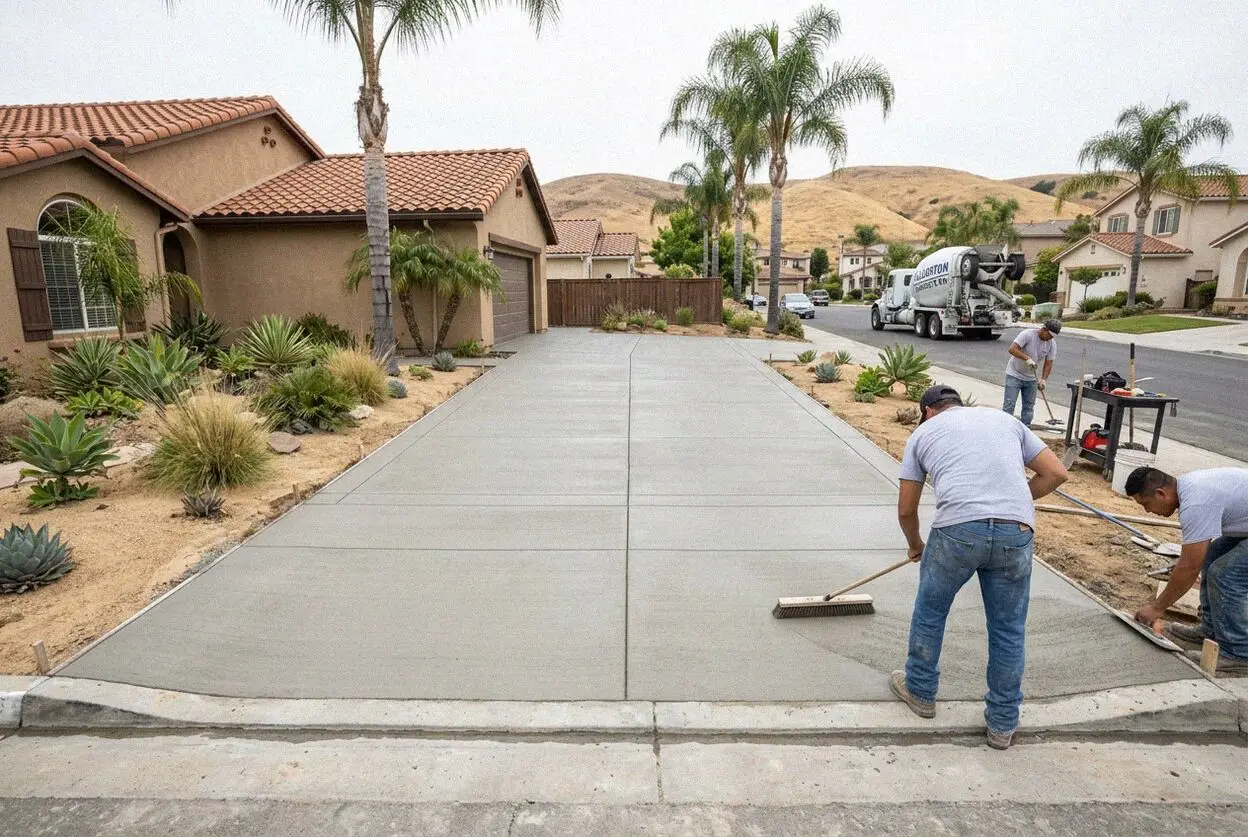
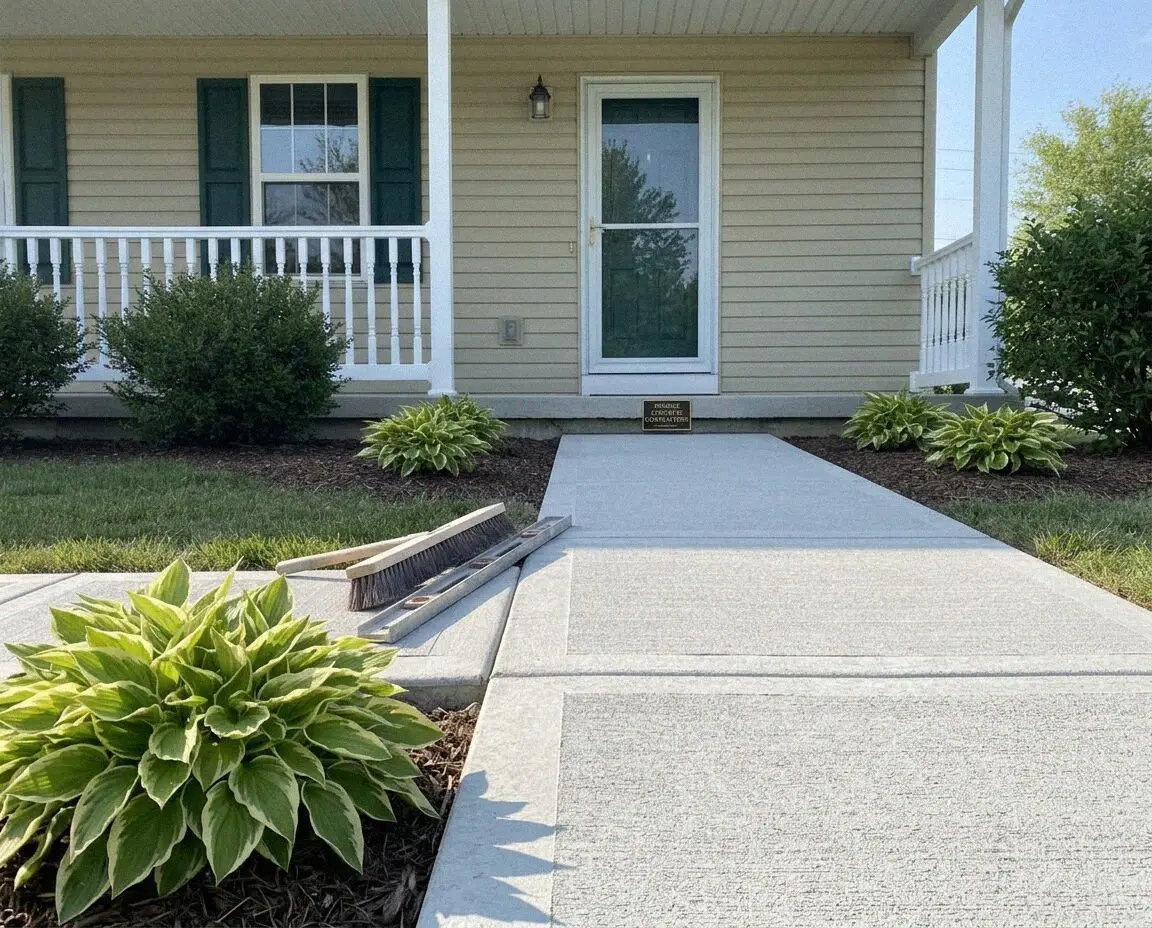
New concrete driveway and apron outside a 1960s Fullerton home
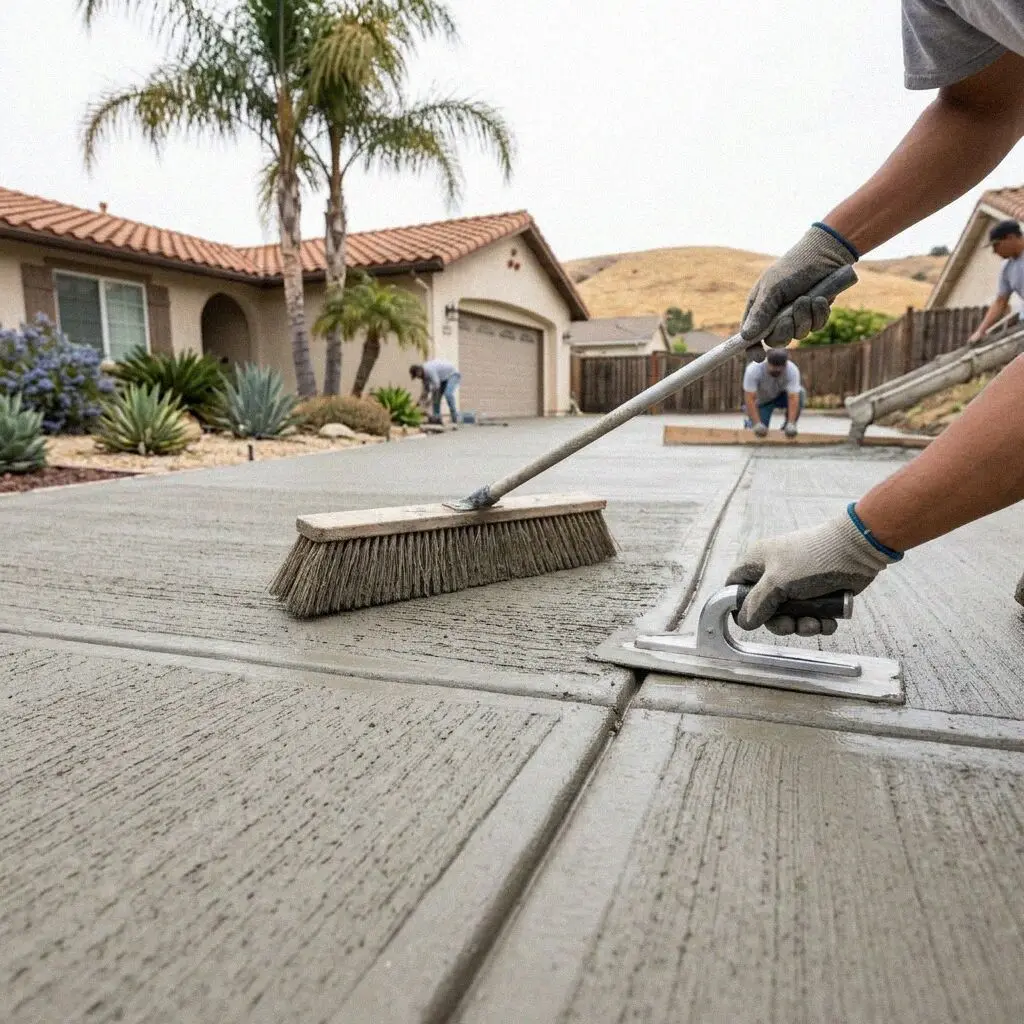
Finishing crew working down a new drive on a Fullerton street

Driveways, start to finish

What a Fullerton Driveway Is Actually Built On

A tract drive is short and it is nearly all apron. Sixteen to twenty feet from the garage door to the walk, splaying across the parkway to a cut in the curb, and every car that turns in loads the same two square yards. So the run is set out from the road backwards: the cut and the approach fix the levels, the slab is squared off them, and the edge taking the turn is deepened rather than the middle.

Harbor Fullerton Concrete was started in 2021 by Grant Yoshida, after 14 years on crews across north Orange County, and he is on the boards himself for the pour. He opens a hole at each end of the run before he prices anything, because the first foot of this ground digs like beach sand and tells you nothing at all about the band underneath it.

liability insurance on every job and a C-8 concrete classification on file with the California Contractors State License Board stand behind every job, and the slab meets the California Residential Code. Both counters sit on one floor: the building permit goes through Building and Safety on EasyDev, and everything from your boundary outward is Public Works Engineering, to the Green Book. What we leave behind carries a written workmanship guarantee against defects in how it was built.


When to replace

Signs Your Fullerton Driveway Has Reached the End

A step just inside the garage door

The panel nearest the house sits on the shallowest clay, because that is where the pad was cut when the tract was graded. The band takes winter rain, swells and lifts that slab against the threshold. Grinding the lip off buys a season and leaves the cause in the ground.

Cracks that open every winter

A gap wide enough to swallow a coin in February that you can hardly see by August is not a curing crack. It is the band a foot down changing volume with the water in it, carrying the slab up and letting it back. Each cycle widens the line and washes fines out from under it.

Crumbling where it meets the road

Every wheel crosses the approach at an angle, so the concrete between your boundary and the curb face fails before the rest of the run does. Loose lumps in the gutter mean that strip is finished. It belongs to the city, so it gets rebuilt to their detail rather than filled.

One side settling on a graded pad

North of Bastanchury the lots were cut and filled to make them level, and a drive crossing that join drops on the filled half while the cut half holds. What you see is a long diagonal line rather than a straight one across the run. The answer to it is under the slab.

What every drive includes

What Comes as Standard on a Fullerton Drive

Eight things on every drive, in the figure from the start. Each answers something this ground or this city does: a shallow clay band, a curb cut the city owns, and a frontage laid out for one car in 1962.

Clay depth found first

A hole is opened at both ends of the run before a figure is written, so the dig is a measurement rather than a guess.

Old drive broken out

The whole run goes down to soil and off the lot that day. No overlay is offered: the old line comes back through it inside a year.

Swelling band cut back

Where the dense clay sits high it is dug away and replaced with angular rock, so the slab is carried on stone that keeps its volume.

Base compacted in lifts

Class 2 base is laid in layers with the plate run over each one, so water drains away instead of standing beneath the concrete.

Poured 4 to 6 inches

4 inches under a car and 5 to 6 under an RV, a load bed or a plant trailer, in 3,500 psi ready-mix. Your depth is on the estimate.

Apron to Green Book

The approach and the curb cut are formed to City standards and the Green Book, which is what the Engineering inspector signs.

Joints sawn the same day

One cut every 2 to 3 feet for each inch of depth, tighter where the clay band lies close up, so shrinkage lands on a line.

Permits filed and met

We lodge the EasyDev application and the encroachment permit, call dig alert two working days out, and meet the inspector.

Choosing a finish

Which Driveway Finish Suits a Fullerton Frontage

All four go down on the same dug-out base, so what you are choosing is the surface and how kindly it takes a lift. On a claypan frontage the last column decides more than the first, because this ground moves twice a year.

OptionLifespanBest onUpkeepWhen the clay lifts
Broom-finish slab30 to 40 yearsA standard two-car tract frontageReseal every 2 to 3 yearsA sawn joint opens; the panel stays flat
Exposed aggregate35 years or moreWest-facing runs that glare in the afternoonReseal every 4 years, rinse each springMovement is lost in the stone texture
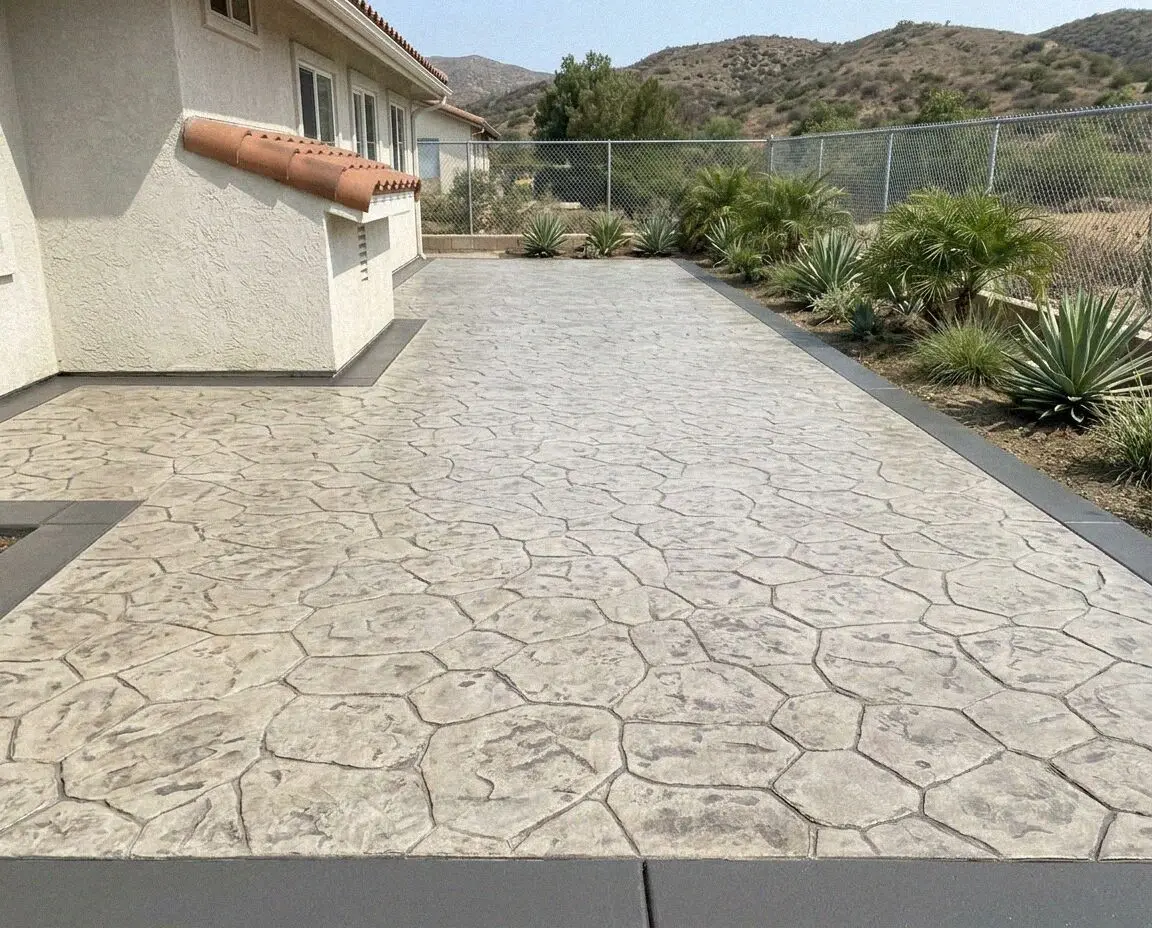
Stamped concrete25 to 30 yearsNewer frontages matched to a patioReseal every 2 years to hold the colorA lifted joint breaks the pattern line
Interlocking pavers30 to 50 years if the base holdsCurbless Pico-Carhart streetsSweep sand back into the joints yearlyUnits tilt one by one out of course

Broom finish is what nearly every 1960s frontage in this city was built with, which is why a plain slab still looks right on those streets and a pattern rarely does.

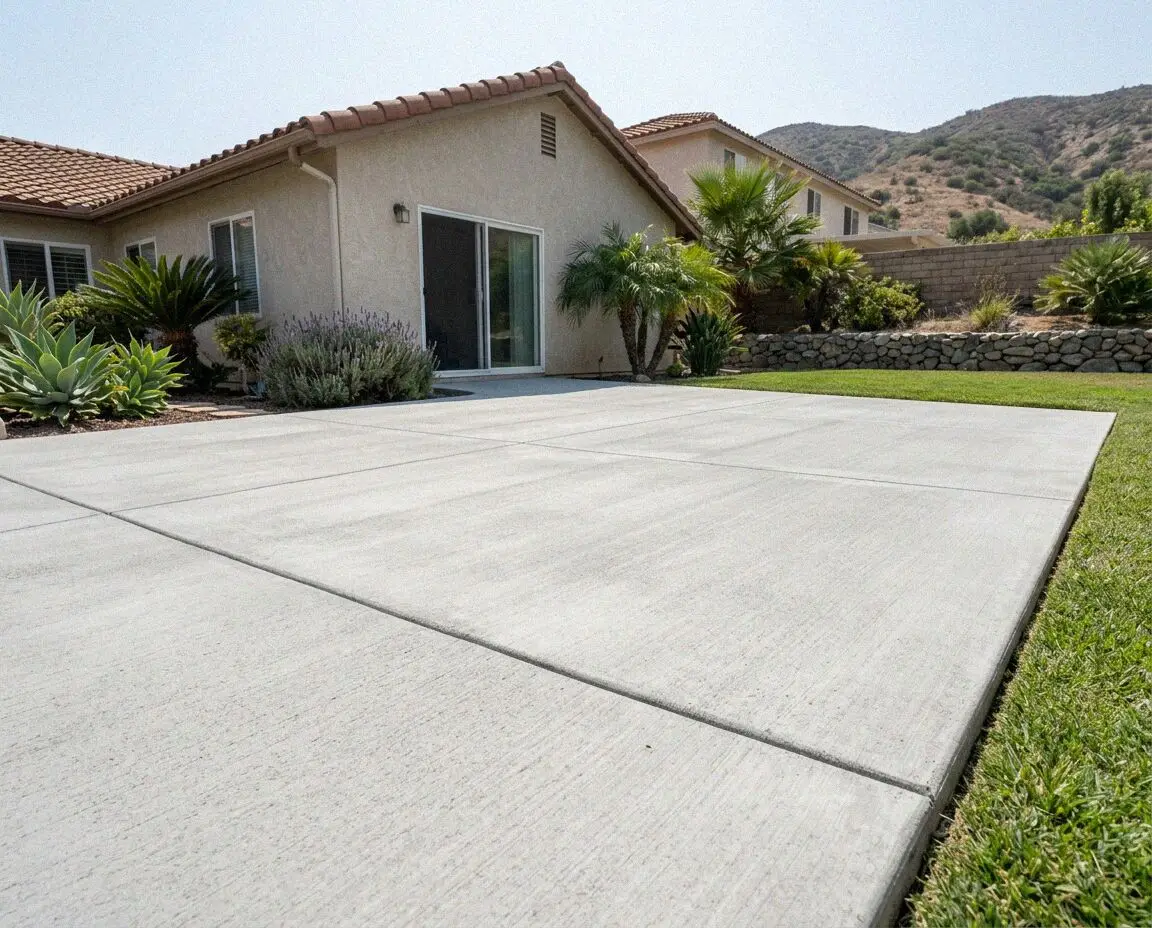
Wide concrete apron and curb cut on a Fullerton tract street

Fullerton in particular

What a Fullerton Frontage Puts on the Estimate

Two things shape a drive here, and the concrete is not either of them: what the postwar tract builders left at the front of the lot, and what sits a foot under it.

Nearly 63 percent of the housing here was finished in the three decades after 1950, so most frontages were set out for one car and a 16-foot opening. The second car has been on the lawn ever since, which is why widening is the job asked for most on this page. Below it all is a claypan: loose sand for twelve inches, then a band near 40 percent clay with a linear extensibility of 6.4, the figure that says it moves. Along the old creek line downtown that gives way to Metz loamy sand.

Two overlays can change a drive before depth is discussed. The Planning Division runs Residential Preservation Zones and the Central Business District guidelines, so work at the front of a house there is looked at for pattern and width. And the Pico-Carhart Rural Street Design Guidelines cover blocks laid out with no curb at all, where an approach is a graded transition into the asphalt instead of a cut, and that detail is drawn first. Both settle before the encroachment permit goes in.

How the job runs

A Fullerton Driveway, Day by Day

From the tape at your curb to the morning the car goes back on it. One crew from breakout to the walk-round, one figure in writing, and every approval lodged by us before a breaker is started up.

1

Measured at the curb

Grant Yoshida measures the run and the opening, opens a test hole at each end, and writes the figure before he drives away.

2

Width, finish, approvals

You settle depth and finish. Where the address falls in a preservation zone or the downtown guidelines, Planning sees it first and we lodge that.

3

Permits and dig alert

The EasyDev application and the encroachment permit go in, dig alert is called two working days out, and the dates are fixed.

4

Breakout, clay and base

The old run comes out to soil, the dense band is cut away where it sits high, and base is compacted in lifts up to the forms.

5

Pour, saw and walk it

Poured with Grant Yoshida on the boards, joints sawn that afternoon, then you walk the drive against your sheet before it closes.

What moves the figure

Why Two Fullerton Drives the Same Size Differ

Area sets the floor and the dig sets the rest. A two-car tract frontage runs 400 to 600 square feet once the apron is counted, and two of those on one street can be days apart. Every estimate is measured and written on site.

How high the clay sits

Where the dense band lies close under the turf, more comes out and more rock goes back. The test hole measures that; nothing is assumed.

Whether the apron is in it

Stopping at your boundary is one job. Rebuilding the approach, the curb cut and the parkway is right-of-way work, on its own permit.

Widening past the old opening

A wider run needs a wider cut at the road, approved separately by Engineering, and it usually means moving where the water goes.

Fall and access at the front

A hillside run off Raymond or a filled pad in the north takes stepped base and hand work along edges the chute will not reach.

The visit costs nothing and the sheet stays with you. Ring the Harbor Boulevard yard or send the form; an answer follows within 1 business day. (657) 500-3759 or send us a message.

Want a figure for your Fullerton drive?

Leave the form or ring the yard and somebody calls you back within 1 business day, and a time gets fixed. Grant Yoshida measures the frontage where it lies, opens the hole and leaves the sheet with you. Nothing is owed if it stops there.

Request a Free Estimate

Written on site · No obligation

By submitting, you agree to our disclosure and consent terms, including being contacted by Harbor Fullerton Concrete.

What owners say

Three Fullerton Drives, in the Owners' Words

Three frontages within a couple of miles of one another: a 1960s two-car run widened at the road, a hillside drive off Raymond Avenue, and an exposed aggregate replacement down near the creek line.

Google review

“We wanted it wide enough for both cars instead of one on the grass. They took the approval for the bigger cut through Engineering themselves, poured 520 square feet at 5 inches and put the apron back to the city detail. Grant was on the boards at seven both mornings.”

Dana W. of Amerige HeightsDriveway widening · Google · 2026
Facebook review

“Ours had a diagonal crack across it and one half had dropped a good inch. They dug down and found the fill where the pad had been leveled, took that back to something firm and rebuilt 430 square feet. Two wet winters and the joint has not opened up.”

Alvin R. of north FullertonHillside driveway rebuild · Facebook · 2025
BBB review

“We are in one of the older houses near the old creek line, where the ground is sand a long way down. They still took it out properly and laid exposed aggregate over compacted rock, 380 square feet, sawn the same afternoon. It has washed clean every spring since.”

Corinne B. of DowntownExposed aggregate drive · BBB · 2026

FAQ

Fullerton Driveway Questions, Answered

Which counter, what widening involves, what a street with no curb changes, what depth a claypan wants, when you can park, why one crack keeps returning, whether the marine layer delays a pour, and what is covered.

(657) 500-3759
  • Which permits does a driveway in Fullerton need?

    Two, and where the work stops is what decides which. The slab inside your boundary is Building and Safety business, applied for through the city EasyDev portal at City Hall on West Commonwealth Avenue. Everything past that line, approach, curb cut, parkway and the public walk across it, takes a Public Works Engineering encroachment permit, built to the Green Book. Both are ours to file.

  • Can I make my driveway wider than it is now?

    Usually, and the limit is at the road rather than at the house. Widening or replacing the approach has to be approved by the Engineering Division before a form is set, because the curb cut and the parkway belong to the city. Inside your boundary it becomes a setback and drainage question instead. We measure the opening, the side gap and the fall, then take it to the counter.

  • What changes on a street built with no curb?

    The last four feet do. The Pico-Carhart Rural Street Design Guidelines cover blocks laid out without a curb, so rather than a cut there is a graded edge running into the asphalt, and how that meets the road is agreed with the city instead of decided on the day. The run behind it is built exactly as any other drive is.

  • What thickness does a Fullerton driveway need?

    4 inches where a car parks, and 5 to 6 where an RV, a truck or a trailer with a boat on it stands. Over a claypan the rock beneath counts for as much, since a slab bearing on a band that changes volume is only as good as the layer spreading that movement out. The depth is written on your estimate, and once it is down that number cannot be revisited.

  • How long before I can park on the new drive?

    Seven days for a car, 28 for anything heavier, a load bed, an RV, a caravan. Driving on early rarely splits it that week; the weight settles new concrete into ground that has not finished taking the load, and the line turns up months afterward with nothing left to blame it on. On foot after 24 to 48 hours. Both dates go on your sheet.

  • Why does the same crack open every winter?

    Because the clay under it does the same thing every winter. The band a foot down takes on rain, swells, then hands it back across a July that averages 84 degrees, and the concrete above rides that cycle. Sawn joints are there to absorb it, and where the band sits close to the surface we bring the grid in tighter and cut it deeper.

  • Does the morning marine layer hold up a pour?

    It moves the hours rather than the date. A damp morning here keeps bleed water sitting on the surface longer, so the crew waits for it to go before floating, and a summer pour in this county is ordinary work rather than a race against the heat. The slab is then watered for seven days while it gains strength, as the Portland Cement Association sets out.

  • What is covered once the crew has gone?

    How it was put in: the depth of the dig, the rock, the slab itself, where the joints fell and how it was finished, on terms printed on the sheet you signed. Stains, ordinary wear and ground traveling further than the joint grid was cut to take are not defects. If ground we replaced settles beneath a panel, that panel is ours to break out and pour again.

Service area

Driveways Poured Near Fullerton

The eight towns closest to Fullerton that we pour drives in, each shown with its distance in a straight line. La Habra is three miles from the Harbor Boulevard yard, and coverage reaches 25 miles out over the Los Angeles county line.

Show All Areas We Serve

Start your Fullerton driveway project today

Leave the form or ring the yard on Harbor Boulevard and you hear from us within 1 business day. Grant Yoshida measures the frontage where it stands, writes the figure there, and the sheet is yours to keep either way.